
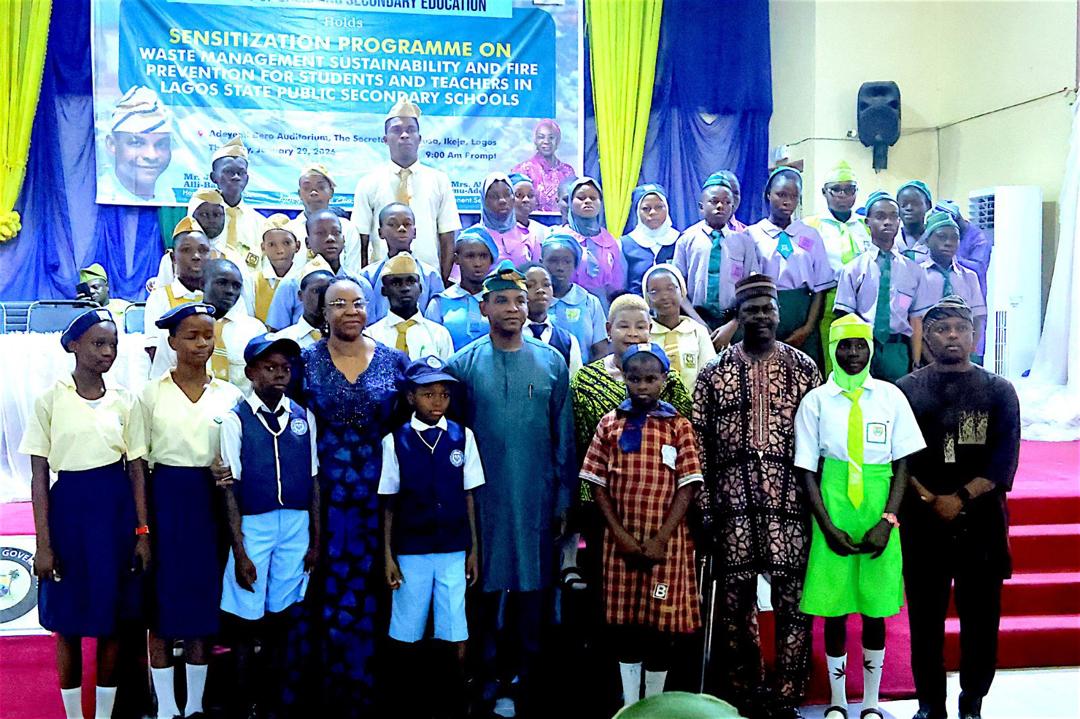
By Aina Shehu
The Lagos State Government, through the Ministry of Basic and Secondary Education, has organised a sensitisation programme on effective waste management and fire prevention for students and teachers from public secondary schools across the state.
The programme, held recently at the Adeyemi-Bero Auditorium, Alausa, Ikeja, focused on promoting environmental sustainability and safety consciousness among students and educators. It featured practical sessions on proper waste sorting, recycling techniques, use of fire extinguishers, and emergency response procedures.

Presentations were delivered by officials of the Lagos Waste Management Authority (LAWMA) and the Lagos State Fire and Rescue Services, covering topics such as the circular economy, sustainable waste management practices, recycling, and fire prevention strategies.
Speaking at the event, the Honourable Commissioner for Basic and Secondary Education, Mr. Jamiu Ali-Balogun, stressed the need for collective action in achieving a safer and more sustainable future. He explained that the initiative was designed to empower students to become Safety Ambassadors who would promote environmental awareness and safety practices within their schools and communities.
Commending the students for taking proactive steps towards proper waste management and fire prevention, the Commissioner noted that simple actions—such as switching off electrical appliances at home and in schools—can significantly enhance the safety of lives and property. According to him, “A safer environment begins with individuals, and the time to act is now.”
Also speaking, the Permanent Secretary of the Ministry, Mrs. Abisola Dokunmu-Adegbite, emphasised the importance of a clean and safe school environment for effective teaching and learning. She described the programme as timely and critical, noting that it addressed issues that directly impact schools and surrounding communities.
Dokunmu-Adegbite highlighted the dangers associated with poor waste management and fire negligence, urging students and teachers to take responsibility for maintaining their environment. She noted that improper waste disposal could lead to unhealthy conditions, disease outbreaks, and environmental degradation.
She further stressed that students, teachers, and school staff must work together to keep classrooms, hostels, laboratories, libraries, playgrounds, and school premises clean and safe. The Permanent Secretary explained that the programme was aimed at equipping students with practical skills in waste sorting, disposal, recycling, classroom hygiene, and identifying potential fire hazards at home and in schools.

Participants were also educated on basic fire prevention measures and emergency response, with emphasis placed on the leadership and supervisory roles of teachers in enforcing environmental and safety regulations.
She urged participants, particularly students, to serve as Change Ambassadors by applying the knowledge gained, maintaining clean school environments, adhering to safety rules, promptly reporting hazards, and cascading lessons learnt to others.